Somewhere in the back of your mind, you probably know your birthday — the month, the day, the year. But do you know the day of the week you arrived? And did you know that day has a name borrowed from a Norse god, a Victorian nursery rhyme written about it, and a statistical story that says more about modern medicine than about fate? Your birth day is hiding a lot. Let's dig in.
Every Day of the Week Is Named After a God
Before we get to your specific day, here's something worth knowing: every single day of the week you've ever lived through is named after an ancient deity. The tradition stretches back to Babylonian astronomers, was adopted by the Romans, and was then reshaped by the Norse and Germanic peoples who gave us the English names we use today.
According to the Old Farmer's Almanac, Sunday takes its name from the Sun (Sunnandæg in Old English). Monday comes from the Moon (Mōnandæg). Tuesday honors Tiw (or Tyr), the Norse god of war and justice. Wednesday belongs to Woden — better known as Odin, the chief of the Norse gods, the Allfather, the god of wisdom and death. Thursday is unmistakably Thor's day, named for the hammer-wielding god of thunder. Friday comes from Frigg (or Freya), the Norse goddess of love and fertility. And Saturday breaks the Norse pattern entirely — it is named after Saturn, the Roman god of agriculture and time.
So if you were born on a Wednesday, you arrived on Odin's day. If you were born on a Thursday, you share your birth day with every thunderstorm that has ever rolled across the sky. There is something quietly magnificent about that.

Each day of the week carries the name of an ancient deity — from Odin (Wednesday) to Thor (Thursday) to the Sun itself (Sunday).
The Nursery Rhyme That Tried to Predict Your Personality
For centuries, people believed your birth day said something meaningful about who you would become. The most famous expression of this belief is the "Monday's Child" nursery rhyme, first recorded in A. E. Bray's Traditions of Devonshire in 1836 — though the tradition it captures is far older. According to Wikipedia's sourced entry on the rhyme, the Elizabethan writer Thomas Nashe recalled stories told to children in Suffolk in the 1570s that assigned fortune to each day of birth.
The modern version of the rhyme reads:
Monday's child is fair of face,
Tuesday's child is full of grace.
Wednesday's child is full of woe,
Thursday's child has far to go.
Friday's child is loving and giving,
Saturday's child works hard for a living.
But the child that is born on Sabbath day,
Is bonny and blithe, good and gay.
Interestingly, the rhyme was not always consistent. An 1887 version published in Harper's Weekly placed "full of woe" on Friday rather than Wednesday — perhaps reflecting the Christian association of Friday with the Crucifixion. The fates of Thursday's and Saturday's children were also swapped in some versions. The rhyme, in other words, was always more folklore than fact — a mnemonic device for teaching children the days of the week, dressed up as prophecy.
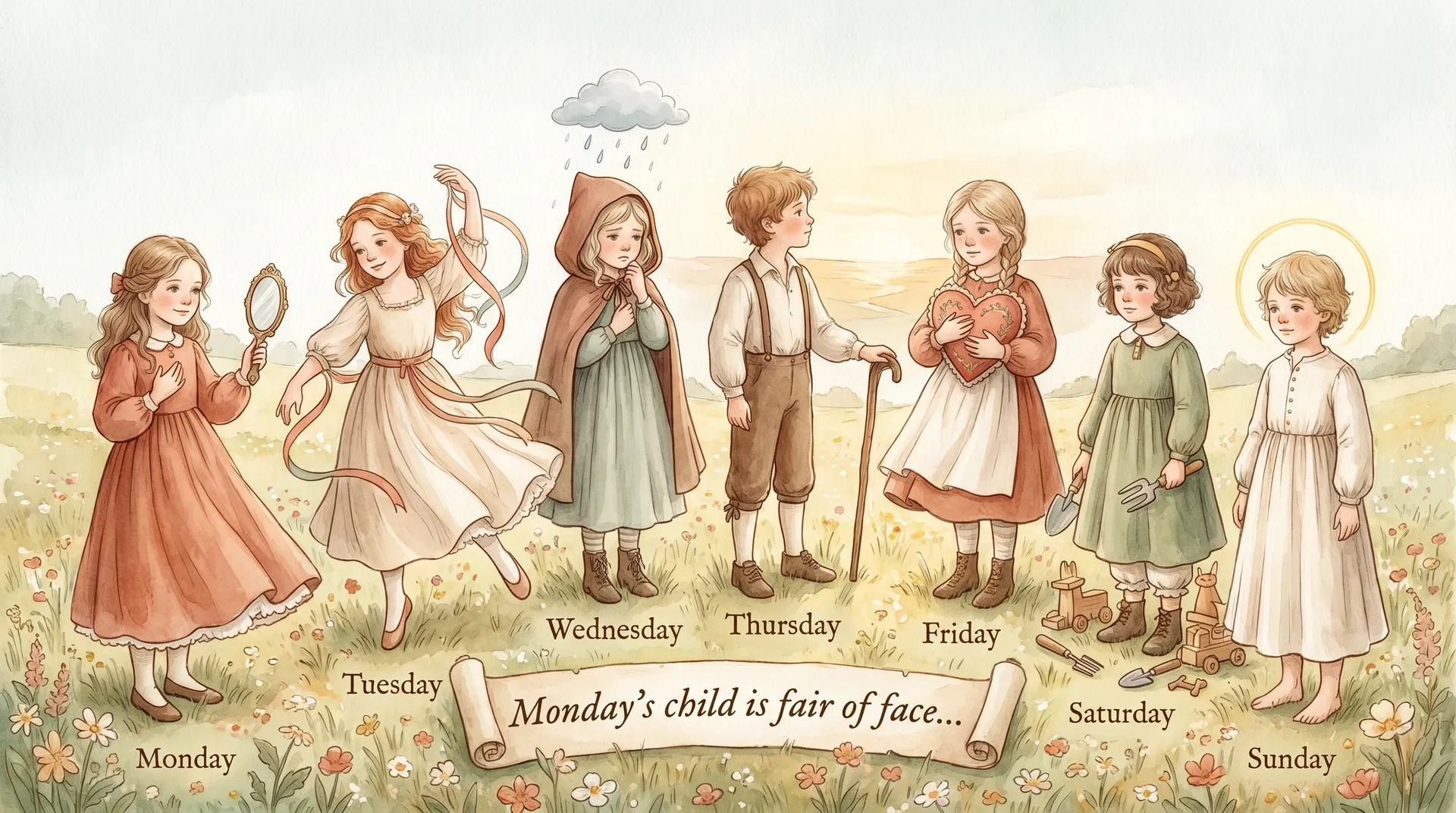
The Monday's Child rhyme dates to at least 1836 and reflects a tradition of birth-day fortune-telling stretching back to the 1570s in England.
What Science Actually Says About Your Birth Day
So does the day of the week you were born actually shape who you are? A 2025 study from the University of York's Hungry Mind Lab, led by researcher Sophie von Stumm and published in the Journal of Personality, set out to answer exactly that question — rigorously.
The study analyzed data from 2,236 children born in Britain in the mid-1990s, assessing them between ages 5 and 18 on every characteristic the Monday's Child rhyme claims to predict: attractiveness, physical fitness, anxiety and withdrawal, academic achievement, kindness, and work ethic. The researchers tested whether children born on Monday were more attractive, whether Wednesday's children were more anxious, whether Saturday's children worked harder.
The result? As Psychology Today reported in its coverage of the study: the day of the week children were born was not associated with any of their measured characteristics. Wednesday's children were no more withdrawn or anxious than any other group. Monday's children showed no particular advantage in appearance. The rhyme, for all its charm, predicts nothing.
This is not a disappointment — it is actually liberating. Your birth day does not determine your personality, your fate, or your character. What you do with your days matters far more than which day you first arrived.
The Surprising Statistics: Why Tuesday Is the Most Common Birth Day
Here is where things get genuinely interesting. While your birth day does not predict your personality, it does reveal something fascinating about how modern medicine has reshaped human birth patterns.
According to CDC NCHS Data Brief No. 200, published by the Centers for Disease Control and Prevention in May 2015, births are not evenly distributed across the week. The data shows a clear weekly cycle: birth numbers increase steadily from Monday through Friday, then drop sharply on Saturday and reach their lowest point on Sunday.
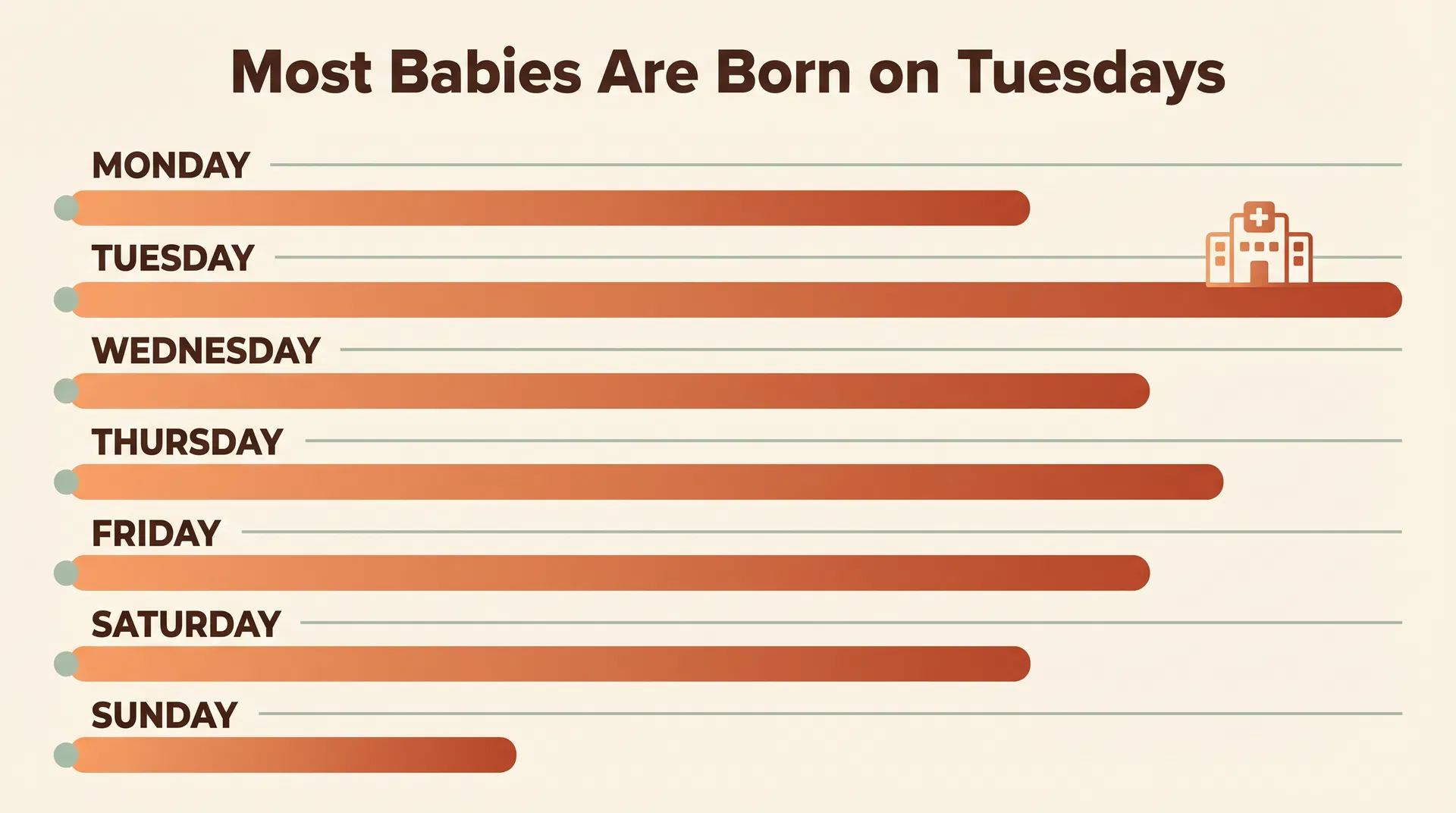
Birth rates follow a clear weekly pattern driven by scheduled medical procedures. Tuesday sees the most births; Sunday sees the fewest. Source: CDC NCHS Data Brief No. 200 (2015).
The reason is not biological — it is logistical. Induced labors and planned cesarean sections are overwhelmingly scheduled during weekday business hours, when full medical staffing is available. The CDC data shows that cesarean deliveries with no trial of labor are most concentrated during daytime hours on weekdays. Spontaneous, unscheduled births are distributed more evenly throughout the week, but they are now a minority of all births in the United States.
If you were born on a Sunday, you are statistically in the minority — and your arrival was most likely entirely on your own schedule, not a doctor's calendar. If you were born on a Tuesday, you share your birth day with more people than any other day of the week.
How to Find Out What Day You Were Born
Calculating the day of the week for any historical date requires accounting for leap years, century adjustments, and the irregular lengths of months — a process formalized by the mathematician Christian Zeller in the 19th century through what is now known as Zeller's Congruence. It is accurate but tedious to do by hand.
The easier path: our free age calculator computes your exact birth day of the week instantly, along with your age in years, months, days, hours, and seconds — all updated in real time. Enter your date of birth and the tool handles the arithmetic, the leap year corrections, and the calendar math in a fraction of a second.
Once you know your day, you can decide for yourself what to make of it. Odin's day? Thor's day? The day the nursery rhyme said you'd have "far to go"? The science says your birth day doesn't define you. But knowing it — really knowing it — is one more thread connecting you to a surprisingly long and fascinating human story.
References
- Old Farmer's Almanac. The Origin of the Names of the Days of the Week. almanac.com
- Bray, A. E. (1836). Traditions of Devonshire, Vol. II, pp. 287–288. J. Murray, London.
- Opie, I. & Opie, P. (1997). The Oxford Dictionary of Nursery Rhymes (2nd ed.), pp. 364–5. Oxford University Press.
- Wikipedia contributors. (2024). Monday's Child. Wikipedia, The Free Encyclopedia. en.wikipedia.org (citing Bray 1836; Opie & Opie 1997; Fox 2000)
- Von Stumm, S. (2025). Does the day you're born influence your personality? Journal of Personality. doi: 10.1111/jopy.70005. Reported by Psychology Today.
- Mathews, T. J. & Hamilton, B. E. (2015). When Are Babies Born: Morning, Noon, or Night? Use of the Birth Certificate to Reflect Time of Birth. NCHS Data Brief No. 200. Centers for Disease Control and Prevention. cdc.gov